04 November 2012

Colours of Tasmania

We have been two weeks in Tasmania - family, friends and anti-clockwise around the island, which is 2% of Australia's population in a space of 1% of Australia's territory, geologically, biologically a recalcitrant fragment of our lump of Gondwana traipsing behind the blathery brazen mainland slowly northward, moistened and blown at to greater and lesser degrees by the often over-articulate Southern Ocean, an extraordinary distinctive diversity, not big but as a lady whose husband told us he drove a cart a hundred miles through its wilds 60 years ago said: "If you ironed it out, it'd be as big as Queensland!"

Compare with France: Caesar saw its limits compared with Tasmania (which perhaps fortunately he did not see): 'Gallia est omnia divisa in partes tres' [the whole of Gaul is divided in three parts]. Tasmania, by contrast, I reckon, is divided into six parts:

  1. the east coast with its mild weather, beaches and seafood;
  2. the north with its comparative warmth and moist climate and extraordinary farm fertility and colour;
  3. the west coast facing the sea
  4. the mountains and lakes of the interior
  5. Hobart and hinterland, old colonial and waters tumbling through pastoral worlds rushing to the sea in 1/20th of the distance the waters of the Murrumbidgee and Murray take from comparable landscape on the Monaro, through comparable vertical distance — and without drying up on the way...
  6. and the sixth wonder: MONA, the Museum of Old and New Art, just upstream from Hobart.
Hobart, Bicheno (via Frecinet), Launceston (via St Mary's), Smithton (via Penguin),
Strahan (via Waratah) and then through winding rainy roads to New Norfolk,
just upstream from MONA and oh yes, Hobart and airport.
We flew and rented a car —
time and money cheaper than driving a car 1000km from home to the overnight ferry
(wilderness failure of his graciousness our 1994 Peugeot diesel also possible!)
Everywhere there is astounding landscape and, more than most of us, Tasmanians actually live in the environment.

There is a warmth of engagement offered by many people, also for the most part modest lives and incomes. Australians who shift to Tasmania are different from those who travel north. They wear shoes, jumpers and they think. The economy struggles, given its small size; there are quarrels over environment. Tourism is a huge element of the economy but tourism is a mixed blessing for tourist-trodden people, not everyone looks pleased to be a servant in a fluctuating industry where the customer often enough is a whinger. "Industry, Industry!" many cry, but (for example) at Waratah, where the tin mine was opened again for several years recently before shut again by the global downturn "...we got nothing, it did nothing, it was all contract, they just blew in and blew out, no work for us, no business for us." Population 200, 50 houses for sale online today.

Predominantly the images of Tasmania in the outside world are of wilderness, especially as inspired by Olegas Truchanas, and the darker hues of the national parks and Derwent, as exemplified by the lovely work of Veronica Youd, in whose rental accommodation we stayed for our two last nights, upstream from Hobart. Predominantly the tourist experience is of the resort locations, but we managed to stay mainly in towns, in reasonably priced houses and apartments. These communities were very friendly and conversational places to be.

My photos below predominantly focus away from the familiar wilderness.

Here is rocky coast at Bicheno at dusk, gulls and children waiting for the parent penguins to come ashore to feed their babies in their fish-vomitty, squarky burrows.


Here is the [Fairly] Big Penguin of Penguin, also under seagull guard

and here perhaps a dreaming of customers at the fabulous and fabled Penguin Sunday Market


Here are colours of the human-imprinted Northwest.  I was staggered by what I could see if I really looked as we drove, thank you Helen for driving most of the way, thank you cameras (now an Olympus E-PL1 with standard zoom or with my old 50mm f1.4:1 Nikon lens to see in the dark) for having enabled me to capture and show such as I began to see in Italy long ago.

CLICK ON ANY PHOTO FOR A SLIDESHOW OF ALL


If you look carefully at the hedgerow above , you will see that this is in fact a photo of the famous 'Nut' of Stanley
... or, it seemed to us, 'StanleyWorld' - so picturesque and fully tourist focused.


Some of these photos are taken from the car at highway speed


and then we headed south through mountains to Strahan which to get to seems way down the west coast but while the most southerly town is in fact not half way down the coast, the rest of the south west being wilderness


Strahan is on beautiful Macquarie Harbour, an old fishing port... but you cannot buy a fresh fish to cook... The population is under 1000, with tourist surges. Retail of anything except catered tourism is precarious. A town which is shaped for tourists, like Strahan or Stanley on the north coast does look like, well, it's shaped for tourists. We escaped not on the rack railway ($133 or $220 per person) which we were told not to miss, but up the road from the supermarket to Lette's Bay where we found the habitations of locals and the wonders of heath plants.


We were in Strahan on two of the few days in the year without rain (the boy on the checkout at the supermarket said it rained 350 days of the year, apologised for the strange weather we were getting.

As Chinese friends might, we looked around here as elsewhere and said 'so many people could live here!' (as did demographer W.D. Borrie in his report on Australia's future population to the Whitlam Government in the 1970s, when he suggested that Tasmania, if developed like Manhattan, had resources for 60 million people, as I recall). But where large populations could be managed in the north, in the southwest the land is more fragile and vulnerable, be it in rainforest or heath. The secret would seem to be in finding the right kinds of settlement (not mind-numbing clear-felling timber) and making it work in the environment with strong local planning, limiting urban spread, building up not out, using modern technology for energy efficiencies, comfort and communication. A leap forward from simply butting heads together in endless arguments.  

Dusk

Macquarie Harbour

We did not go back to Hobart at the end of our trip but to its western edge, at New Norfolk, again choosing a town not a resort. Here is a view down the Derwent (Hobart not far down there by road but out of sight) from a lookout opposite New Norfolk.


Down there, where a small river, the Lachlan, enters the Derwent on the right, we saw a platypus. Taken me almost seventy years to see a platypus in the wild... ! 

Here is a little movie:

THERE IS A LITTLE DEVICE TO CLICK

AT THE BOTTOM RIGHT OF MOVIE

TO SEE IT ON FULL SCREEN


~~~~~ AND SO TO THE SIXTH WONDER


We find the new MONA to be a gallery of world importance—and the world seems to be coming to see it now. It is so good to be able to wander through and be immersed in a whole enclosed environment, the underground building and the art, without interpretation everywhere. You can delve into lots of commentary on an iPod-like device provided. The senses and mind assaulted variously, mind-shifting: don't go if you don't enjoy that.

It hides in a vineyard in a suburb. on a small peninsula on the river.


The staff are not haughty or intimidating but smile and converse. 

You can use camera but not flash. This is an odd collection below. So is MONA; not appropriate to try to add some form, other than perhaps my own sight,.... also I was absorbed more in the visceral than the digital and the camera battery died. 
Photos have their own life and meaning, these are from me, not MONA. And as usual, the people are art forms too.

Well yes, there is a bit of printed info at the beginning...


People do look beautiful


The artist's statement for this hollowed out recumbent full sized human form is:
This work, with its glass display case, 
draws attention to the sinister way museums and art institutions
 alienate visitors from their own emotions.
—very much a statement of what MONA works hard to avoid being.


MY BEAUTIFUL CHAIR 2010

Greg Taylor. Dr Philip Nitschke

He has tapped the screen and assisted death is under way,
on his own initiative and by his own decisions.
He did not have to sit there and discover the experience.

This is a very moving exhibit.
The thing in his hand is not a needle in his arm, perhaps his finger makes the point.
Here we exit. Moved and alive.

OR WAIT,
THIS IS NOT AT MONA BUT PERHAPS IN THE SPIRIT OF MONA
...
and to lighten things up again


21 October 2012

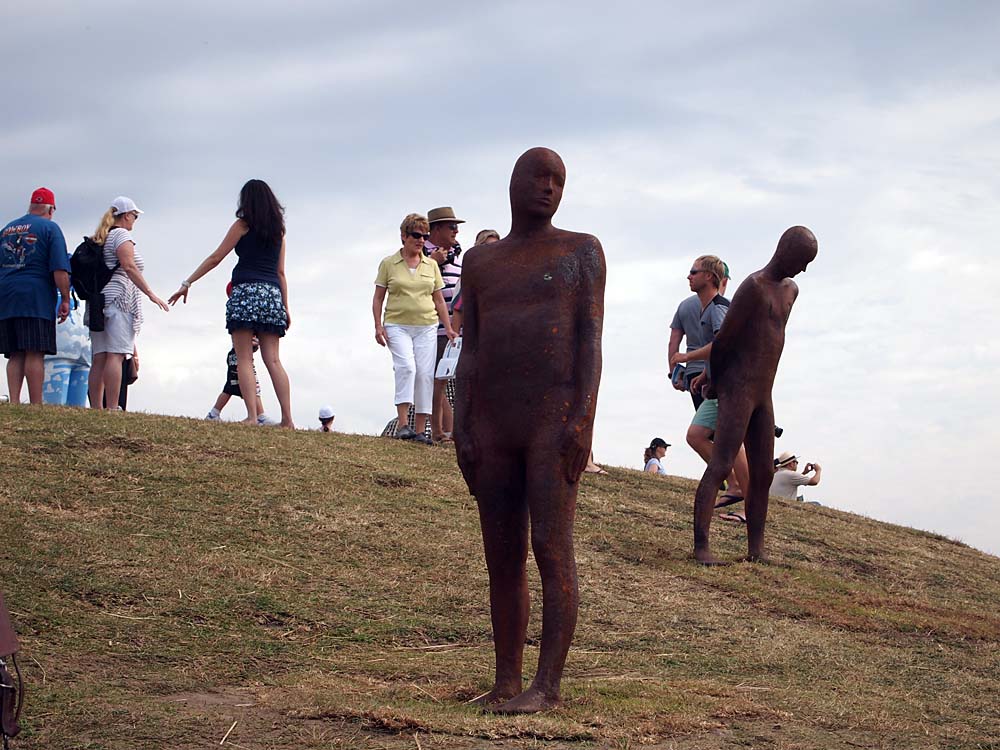
PHOTOGRAPHY: Sculpture by the Sea


There is, each year, on the cliff walk from Tamarama to Bondi beaches, in Sydney, Australia, a 'Sculpture by the Sea' exhibition. We went to see the 2012 exhibition early on Sunday morning 21 October — early for light, also early before the Sunday crowds. There were lots of people there already.

It is not an easy thing for the exhibitors to compete against extraordinary scenery, a mass of alive people, a parade of animals, not just people's pets but also (we estimated) perhaps a hundred dolphins hunting in the waters below the cliffs. I have not tried to produce a catalogue, the images include some of the distractions, some things that catch the eye with beauty extraordinary or ordinary.

Nature provides its own spectacle... and (below) the passing human parade provides proportion


This object provided dramatic contrast with natural forms. The net below, placed near the steps above, when looked at directly did not have the same force as that above. But looked at from the south, looking into the morning sun, and with humans turning their backs to it, to see the sea, it gets context.

Is the fisherman planning theft?
With the worshipping photographer, this seems to have a religious quality.
It is indeed a photographer's day out.
He with the professional air is Gary Blackman aka Manly Beach Adventure Photography.
I deliberately over-exposed the shot, looking into the morning sun reflected off sky and sea,
to intensify focus on the main subjects.
I take the liberty of not straightening the quickly-taken image
so as to add weight to the leaning on the donkey. 

Mainly people just walked past this, but it intrigues.
Clearly something happens to the seas below this cliff.
The 'Southern Oscillation' of the Pacific Ocean, which sweeps water up the coast of Chile and Peru and then westward before turning southward along the east Australian coast means that there is a point on Australia's east coast where warm water from the north meets cold water from the south — a point which moves north and south depending on the strength or weakness (causing El Niño weather patterns) of the Southern Oscillation.
I don't think this is that point, but I wondered... and I could not resist mentioning  :-)
Apart from the sea itself, there was a lot of human interest in dolphins fishing below.
I don't have a dolphin photo...

These next photos show works in human context


while these next photos show intriguing objects without human context

... and as we have a lot of bamboo on our own property, we realise this first photo offers a new idea on how to keep birds at a distance from fruit.


—and these photos taken inside the dome have an eye- and brain-confusing quality
that did not exist when your eye is there. 
Photography is not a literal record, not a copy.  It has its own life.[CLICK ON PHOTOS TO ENLARGE]


I continue to be distracted by or engaged by the crowd.
Towards 10am the crowd is thickening.
People are interesting,
in themselves and in the things they do and especially in their self-absorption.
Some see more than others. Only once did I hear a sniping use of the word 'gillard' — by an older puffing woman, interestingly as a new noun, perhaps for the Macquarie Dictionary***, not as a proper noun:
"You're not going to do a gillard are you?"
*** I've put the link from 'Macquarie Dictionary' to the Guardian newspaper report. 
The Guardian, unlike any Australian newspaper, 
notes that Macquarie were a decade behind the Oxford Dictionary
in making a change in definition of misogyny.


often enough in galleries I am distracted from the 'installations' 
to admire small miracles of non-artist origin, as below


Towards the northern end, creative items using common objects:
 one for fun in own context, one doing something quite original


and then to arrive at Bondi Beach... people, nature and objects


22 September 2012

pivotal strategic moment

I said in an entry in this blog on 10 August that we are now in what seems the most important pivotal moment in Australia–China relations. It seems also the case with Australia's relations with the United States, though we don't seem to know it and, still largely asleep, may slide into an absurdity in our alliance with the US.

I was astonished today to see that a report of views of Edward Luttwak, commending our support of an American policy of containment of China, filled half of the front page of the Sydney Morning Herald, notionally a very sensible old Australian newspaper.


I wrote to the Herald thus:


Your Luttwak front page
I am astonished that you would give the front page to reporting Edward Luttwak's views on the containment of China. To have him enter the debate regarding Australia's relations with China and the United States should cause reflection on where we are going in supporting foolish American strategic policy.  
Since the 1970s he has spouted a dangerous nonsense far to the right of Henry Kissinger. He sees international relations as bizarrely abstract, a duel between great enemies, with all the countries in the middle proxies or pawns. He certainly has no real notion of Australia or Australian policy as other than a manipulable. He does not know, does not really have regard for Australian interests.  
He speaks not of China but himself when he writes, as you quote: "The Chinese are autistic in dealing with foreigners, they have no sense of the 'other','' he said. ''They think they are incredibly brilliant strategists as if they had been conquering other nations, when in fact it's been the other way around for 1500 years.''

The notion of containment of China is a huge strategic error. It could not work and as a frame of mind can only aggravate issues in the region, establishing hostile mindsets, reversing trends towards the construction of diplomatic and political infrastructures for development and the resolution of disputes.

====

There is another disconcerting development today, with reports that a State Department spokesman has said that the the US-Japan treaty covers the Senkakus, islands called such by Japan, also claimed by Beijing and Taipei, known in Chinese as the Diaoyu Islands. Wikipedia provides some account of the territorial dispute, Japan regarding the islands as having been terra nullius at Japanese occupation at the time of the China-Japan war of 1895, Chinese governments claiming otherwise. There has been a considerable escalation of tension in relation to these islands and claims to them recently. The importance of the disputes arises from contest for seabed resources. ASEAN countries, Korea and Russia as well as China and Japan are in the mix of this. The best current resource on this subject is Geoff Hiscock's new book, Earth Wars: The Battle for Global Resources available on paper or Kindle or from iTunes. 


Bringing the US-Japan Security Treaty in and in this way is serious. The Americans, in pre-election mode, seem to be racing ahead on this issue. Also as if they were still repaying for the Acheson 'doctrine' of 1950, thought contributory to the Korean war... or imagining that global security still works as imagined to work then.

The texts of US-Japan and ANZUS treaties are here


Everybody rushes to Articles IV and V of ANZUS, Art V of US-Japan, the bits referring to military support, but really ought to spend a little more time on Art I, this the first sentence of Art I of the US-Japan Security Treaty: 

The Parties undertake, as set forth in the Charter of the United Nations, to settle any international disputes in which they may be involved by peaceful means in such a manner that international peace and security and justice are not endangered and to refrain in their international relations from the threat or use of force against the territorial integrity or political independence of any state, or in any other manner inconsistent with the purposes of the United Nations.

We should be saying to the Americans that we would not consider ANZUS to apply in the case of US at war with China over Diaoyo/Senkaku islands. If the Americans want to say 'we are just upping the stakes' then that would be folly of the first order, to live or die regretting. 

20 September 2012

China-Australia

There is now a great blathering about Australia and China in the media, perhaps it will eventually come to something coherent, but Dennis Richardson's comments (summarised here), which veer into loose language and thus into inappropriate political argument by a senior official, tend to sustain feuding rather than coherent perspective. More and more it appears we have in the discussion a general ignorance of both US and Chinese strategic policy, trapped like some Dostoevskan double, projecting our own whims and fantasies about what those countries may be and may want.

I should stay away, do other things... but to this discussion at Club Troppo - part 1 and part 2, I offered comments, here, here and here. It's curious to join discussion in what is some sort of 'club', with academic base, you have a sense in relation to much of the discussion that you are very much an outsider in a university tea room conversation.


10 August 2012

pivotal points in the Australia-China relationship, the biggest is now

This week I spent about three hours at the National Library of Australia recording an oral history interview on Australia-China relations from the perspective of my own career and views — as part of a collection being made by the National Library with the support of the Australia-China Council (their website and activity interesting) and the Department of Foreign Affairs and Trade: interviews with former Australian ambassadors to China under the title Behind the Cables. 

At the National Library web site
I have found this Australian Archives
photo taken for a passport in January 1972,
when I was China desk officer.
The ways we were....  :-) 
My government-related role in relations with China covered the period from 1970 to 1985 as desk officer, section head, branch and division head and as ambassador to China. I also had a watching brief when in the Washington embassy 1976-78, while senior advisor to the deputy opposition leader in 1978-79 and later when head of the research service in the Commonwealth Parliamentary Library 1989-91.

I argued in the oral history that there have been four pivotal moments in the relationship:

  1. the shifting of recognition and diplomatic relations from Taipei to Beijing, from one claimant of the title of government of China to the other, in December 1972;
  2. the Fraser Cabinet decision in 1980 and ensuing action to add substance to the bilateral relationship, to shift it from an international political plaything (words I find now, not in the interview) as it had continued to be, towards a mutually beneficial substantial relationship of value to successor regimes in either country, supporting the development of a civil and productive society in the course of China's modernisation;
  3. the events in Tiananmen Square in June 1989 and the fracturing of the political dimension of the Chinese reform movement;
  4. the present time, when China's emergent predominance in world affairs is the subject of wide debate and requires us to shift from a neglect of broad perspective of the relationship while we (people and government) have been focused on the money. The big new deal has snuck up and people are calamitously confused.
I have commented in this blog on the current debate (or rather, have provided links from this blog to places where I have engaged in the debate). Recently I commented on a piece by former Prime Minister Fraser at Project Syndicate and we discussed this subject further on the phone: he is very concerned that we need to shift public policy significantly to sort out both our relations with China and the United States. Malcolm Fraser's 2012 Whitlam Oration is well worth the time, a critical contribution. And this week former Prime Minister Keating has added a new substantial contribution ... though his views are well established this is the time when it is important to have them set out again. 

I recently copied to this blog some views I have on the difficulty in shifting public policy. I am not at all sure that the high minded articulations to which links above will get through and shift us from reactive muddle to sensible new strategy.

There are white papers on Asia and defence to come in the next year (see this commentary). There is also a federal election next year at latest. The capacity of major parties to adapt is poor; minor parties have difficulty adapting beyond narrow interest dogma. We are trapped in the adversarialism of Australian politics in a particularly vicious way, imposed especially by a conservative-side search for support in lowest-common-denominator fear mongering, a habit perhaps two decades old and now desperately inhibiting of creative thought, desperately damaging to public trust in government and public policy.

How does the demand for security and invulnerability among people, leaders and the media damage us? Listen to the TED presentations of Brené Brown, here and here. Yes, you need 20 minutes for each but they will be well spent. 


29 July 2012

and around

Researching the novel, I have been reading Wei Jingsheng's astonishing letters. Which include his letters to Hu Yaobang in the early 1980s... delivered or not at the time, they will have been received in the novel, they will be discussed, as the liberal minded leaders n Beijing struggle with the ideal and the possible, between dinosaurs and impatient reformers. Informed by He Yuhuai's wonderful Dictionary of Political Thought of the People's Republic of China, plus my knowledge of the Hu Yaobang and Hu Qili... albeit knowing so little at the time of what they were doing behind the scenes.

Drawing remains an important balance, a mental diversion. I recall hearing the incomparable Joni Mitchell say she needed a second art form (painting plus poetry, she said: perhaps, just perhaps, she has three?) for balance and creative energy. And drawing requires some courage, the plunging in is like the plunging into fiction.

I have a dislike of the rigidities of rectangles, hence some preference along the way for painting objects. But having some time ago picked up in someone's kerbside chuckout in Sydney (how to furnish your house well and interestingly for cost of travel) about 20 old canvases, I have just done a life-size drawing over three canvases, something of a triptych, not a rectangle, nor separation between the canvases. The textures of the three canvases differ and thus the mood of the three parts, impacting on the three figures. In total about 150cm wide, 135 high.

Fun, light relief...Title is:

"No, he's not here, but we're looking for a soprano"


21 July 2012

thinking about reshaping public debate in strategic policy

Already the reader is bored by the subject line, blah blah...

But it seems to me and some others that Australia, not least with its excessive entanglement in alliance with the United States, about which I have written previously, faces a difficult future.

We have to change direction.

So I sent these thoughts today to another in discussion about how to bring about such change:

QUOTING MY EMAIL SENT TODAY, 21 JULY 2012


Some reflections….evolving Saturday thoughts. 

The article linked here and from it this comment in particular:

At the end of the day, our populations just don’t really care enough about something that might cause problems in the far future, so they want the politicians to pretend to be doing something as long as it doesnt interfere with business as usual. 


… the puzzling tendency of states and their leaders to act contrary to national interests: why did the Trojans open the door, why did the Aztec' give in to a bunch of Spaniards, why did the Popes spend up and lose half the church, why did the British so rigidly stay with a silly point and lose most of North America, etc.

And then reminded of Robert MacNamara's 1987 book Blundering into Disaster ... MacNamara sternly opposed to 'blundering'.

My view is that 'blundering' is essential to progress: that the event that broke the long-stuck opposing postures of the US and USSR was when Reagan and Gorbachev put out their officials from their talks in Reykjavik in 1986. 

The record may show the talks as failure, but I think this event ended a long stuckness. Such statesmanly blundering to be contrasted with the orderliness of MacNamarian persistence in going down roads without blunder, on the way to disasters. 

So if there is to be a breakthrough in thinking, it seems to to me to have to occur in some breakthrough, albeit prepared for, blundered-into-and-seized-upon manner. As maybe, maybe, sanity in managing life on increasingly wilder Sydney streets could come from reactions to one mad death. Maybe. 

After a day of thought I am not optimistic about brick by brick construction of new vision, the questions are what will be the 'days' and how to seize them. And answers 'can't tell' but have to have contingent thoughts. 
===
Here are links to my past thoughts on relevant issues:

On Iraq:


… from which the most important point to which I stick is the erosion of ability to think in terms of conflict resolution, conflict avoidance, win-win outcomes. The national politics and the 24 hour conflict-focused media madness are no help. 

We remain, in my view, strategically in early moments of something like a glacial unfolding of WW1, without a clue of how to do other than follow the paths we did then:

Our present situation [I said in 2004] is not just like following or obeying or egging on the United States in Vietnam. This is much more terrible than that. This is indeed a new world war, one which is no better comprehended than was what happened in 1914 then. 
In 1914 and again in 2001, there was a rush to alliances, a taking of sides that polarised and made more enemies and closed avenues for peace making and conflict resolution. 
In 1914 and again in 2001, there was expectation of swift victory — the French in 1914 shut down arms factories to hurry men to the front. Today United States military forces are being unsustainably chewed up at reserve as well as regular level by longer-than-planned war. 
In 1914 and again in 2001, there were flushes of nationalistic fervour and there was castigation of opinion opposed to war policy. Let us remember that Keith Murdoch, Rupert Murdoch’s dad, his inspiration, achieved greatness by his journalistic campaign that reversed policy and produced withdrawal from Gallipoli. We did not stay the course there. We call on the media to take a stand against closing down the vocabulary of public debate. We reject the idea that you can have a free press if it just follows the drumbeat of the War on Terrorism. 
In 1914 and again in 2001, there was only a war policy, only a bunch of advisors with maps and war plans and notions of taking the war to the enemy. If you only plan for war, war is all you can get. We reject the idea that war is the only option. 
In 1914 and again in 2001, there was no real thought that there were issues to be resolved between the rich and the poor, to resolve disadvantage, to redress the balance between those who consumed most of the world’s resources and dictate terms in world affairs and those who had no such share of resources and who resent being dictated to. We reject the idea that the United States or Australia has a divine right to shape the world. We affirm our readiness to listen to people with different voices from different cultures and to learn from their wisdom. 
In 1914 and over the years that followed, as in 2001 and years that follow it, we see political leaders create a situation where they must remain consistent with already failed strategy. They must chew up more lives, because to do otherwise risks not just their own positions but the whole posture and shape of state power they have built up to reinforce their strategies. So much so, that rivals, like Bob Carr - and even the rock singer - have to speak the same language, have to say yes they will fight the War on Terror, otherwise they themselves fear being political losers because the whole political vocabulary has been distorted by fear and misinformation. We say to ALL political leaders this: we reject the macho thick-skull notion that you can’t change your mind. We will support you in any pursuit of sane new policy directions to other than war.

That bears on the alliance but is wider than the alliance. I expressed this view to [then Australian Foreign Minister Alexander] Downer in 2003: 

I have become increasingly of the view since that it is in the nature of modern war that it tends, more than anything else - certainly it does not tend to ‘victory’ - to import into the righteous invading countries the problems you seek to eliminate by invading.
You will of course be able to say: “See, I told you terrorism was rising and we had to act.” But at some point you will have to acknowledge some responsibility for that: validating the use of violence to pursue personally defined righteous objectives, then steering the focus of foreign policy to a singularity of security mind-set such as we had in the 1950s.

It seemed such an irony in 2003 that we, armed with self-righteous indignation, went into Iraq to whack them around; shortly thereafter the government launched a ?$20 million advertising campaign against the righteous indignant use of force in domestic violence. 

I can't find statistical trends over past decade in domestic violence. My impression is that all sorts of outrageous behaviour has become more commonplace. It has had official endorsement, the example of state policy.

It is part of the fabric of the times - part of why I think that one has to go deeper to overturn a keenness to lock-step with the US militarily. The vocabulary of strategic debate, put into uniform from 2001 onwards has gone viral; the absorption with security gone ubiquitous. As my Fairfax regional paper editor friend puts it: "We have people here who would write letters to me if they saw a gathering of white youths with bibles in Junction Street, let alone with skateboards, let alone Aborigines." One cannot imagine that in bringing the word 'sustainable' into the vocabulary in the 1987 Our common Future Ms Brundtland would have expected so soon to have it applied to accountancy, gambling and beyond. Same language process. So... what language to put into the populist pot now?


I don't find the word America in Ken Henry's most recent speech on the White Paper
but the American questions must be dealt with in the Asian Century white paper. How do you get traction in response to the White Paper? I assume it will be out before your September speech.


This amazing statement in the 2009 Defence White Paper has to be pulled down:
"The United States will remain the most powerful and influential strategic actor over the period to 2030 - politically, economically and militarily. Its strategic primacy will assist in the maintenance of a stable global strategic environment."
[para 4.14 accessed 14 Mar 2012]

Thoughts of Saturday…. Enough. 

D

18 July 2012

returning to novel

It remains unclear whether the novel which got stuck early in 2011 can form a coherent whole. People (including masterclass mentor) say "how does it end?" Strange thing: we want no clarity of ending in life, we want novels to work towards clear ends. I am more driven now by the perspective of Ford Madox Ford as I have quoted at last week's update of my aplaceof.info. No narrating, let the text be alive through impressions. And for me, the writer, let it find its own end/s.

Initially focused in southeastern Australia, I thought I was in control until one character told me he was Aboriginal and then my lead character told me she was Chinese and had a huge history. This latter  made my way forward difficult, as did distractions like living in Italy early 2011 and ill-health later in 2011.

Restoring momentum, getting back to a situation where the novel chatters in my head daily, has had to wait. It is working now, and writing flows. On 7 July I wrote 50 words – good words, a doorway, I thought – on the eighth another ten, then rushing to 1500 cryptic words... It was a good process to read the draft daily and find that the text was obscure because I did not understand what was happening. I figured that out as the story grew to the present 4000 words.

I do not have the matter of eventual shape settled at all, but I know a core issue to be about how people interact, how they relate for any length of time, when the traumas in their lives have been disparate in scale.

For the China half of the story, I have had to research, add more background to what has been in my head of the times and certain people. The excellent news this past week is that my main character has begun to write her own story and I find she has a point of view, or is developing a point of view, which I had not anticipate. The 4000 words just done, grounded in a moment of Beijing politics, 6 December 1978. I am including real people but as my characters are fictional the place and utterances and attitudes of the 'real people' are also fictional. I am not writing a history, though I find in exploring the way through modern Chinese history through the mind of a young intelligent woman that I gain insights myself as I hope may others. The novel will have a bibliography. I place this draft here for any comments. It may be torn up eventually, who knows... as Lionel Bowen said to me when I was writing speeches for him long ago, "You've got to remember, kid, the best speeches are the ones you never get to give."

Here some links for reference:


The Democracy Movement in China, 1978-1979: Opposition Movements, Wall Poster Campaigns, and Underground Journals


Wikipedia:

Wei Jingsheng

06 July 2012

... and again on China

There is a continuing discussion of China on the web. I have commented on a piece today by Prof Pei Minxin, at the wonderful Project Syndicate web site. Pei is known for arguing that China is going to fail, variously.

My comment as follows:

Elsewhere Prof Pei has spoken of China's government as a statistical outlier in its longevity among autocracies.

China is also an outlier for its population size and consequent governance issues, its poverty and the historically unique rate of revolutionary change and its climb from poverty since 1978. 

There are problems with generalisations for the whole country. I was saying to people in the 1980s that the Chinese coastal strip contained at least four equivalents of post-war Japan, not like the 'little tigers' of Taiwan, South Korea, Hong Kong and Singapore, but on the scale of Japan itself; same picture more dramatic now. While other parts of China are less developed. 

The discussion in Prof Pei's later paragraphs about problems of accountability might be put in context of the way things have gone in western economies in recent times. There has not been much on offer for China as exemplary (or successful) political or commercial conduct in the US or EU or Russia, or India in the reform era from 1978.

I have argued elsewhere that Chinese leaders work with more freedom, plan with more freedom than currently evident in many western democratic systems or academic institutions. 

I am not aware of any thread of political desire in this generation (or the next, the graduates mentioned) to break up this unprecedentedly large country, apart from some elements in minority populations. 

If we say there are problems for the rich and productive in China in getting more deeply into the markets of less developed parts of China, compare the EU dilemma, Germany needing to sustain and build its poorer and 'less well governed' fellow EU members if it is not to lose its own wealth. 

Mind you, I worry about my country's 20% GDP dependence on exports.
.. while having more confidence in China's government to address big new issues than I have in the capacities of my own country's political system, let alone those of the US. We need to think about ourselves when doing this too-common rough-up of China.

Yes, there are dinosaurs in the Chinese system, I recognise them because they are familiar locally. But there needs to be something more than this kind of statistical chartism, some more refined political examination, to really claim that China is on the verge of collapse. 

I am concerned not least because arguing in the United States about China in this way has for decades fed adversarial ways of thinking about China, which do nothing to lead towards positive outcomes. Feeding the kind of thinking that still imagines Reagan brought down the Soviet Union. Construction of collaborative connections with China by the US, Japan and others including Australia, is of the utmost importance for global security. We will all do better if we shift from zero sum gaming, make room.

03 July 2012

Australia-China

I have contributed another paper to the Lowy Institute's blog, the Lowy Interpreter, regarding Australia-China relations.


It is not a simple matter to derive opinion from personal history on an issue, at least when one had a role in matters within the public service, in advice to different governments and when one retains obligations to sustain the privacy of advice in some respects. My reflections on the policy process within government in this article do not extend to more recently than 1985 and speak of one Cabinet submission and decision, from 1980, which is now in the public domain.

I was conscious in writing this commentary also that I reveal something of what happened in my head and my actions and recommendations, advising on sensitive policy. This is important, I think, to provide a better view of the incremental nature of policy development and the role of officials in the process. I am especially conscious that when in 1980 I was developing a Cabinet submission about Australia-China relations, the relationship had gone out on a very narrow limb, with the traditional base of the relationship in Australia, within the Labor Party, then in opposition (I had just returned from advising Deputy Labor leader Lionel Bowen MP on foreign policy for two years), not entirely impressed by China's attack on Viet Nam in 1979 and the fierce suppression of public opinion at the 'Democracy Wall' which had preceded that in Beijing. There was great uncertainty about the political leadership in China, the legacy of Mao, and the role of Deng Xiaoping, described by me in an analytical paper with the Cabinet submission as the second most divisive leader in modern Chinese history (after Mao). Li Xiannaian came to Australia as "the most senior leader you will be seeing for a while" [Chinese officials] because the Premier Hua Guofeng was about to get rolled.

Eventually Deng gave power to Zhao Ziyang as Premier and
Hu Yaobang as communist Party General Secretary
(centre of photo, April 1985, in what at an earlier time
was Mao's bedroom in Zhongnanhai,
meeting before Hu visited Australia)
but Deng later tore down Hu Yaobang
 because of his liberal political views;
Hu's subsequent death in 1989 precipitated
the events in Tiananmen Square. Zhao Ziyang had replaced Hu
 as General Secretary
but also fell because of his liberal views
during Tiananmen, see secret diary.
Hu Qili, also in that photo, right,
 then head of the party secretariat,
was shifted to powerlessness (where he remains, smiling)
for opposing martial law in 1989.
On 1 May 1985 Hu Qili had made a major speech
calling on people to break through outdated Marxist viewpoints
 conflicting with present day reality and
build up a new theory justifying reforms.
This gives me hindsight into Hu's droll remark to me
in August 1985, as regards progress in
setting up a major party conference:
"I suppose you could say we are
making as much progress as possible
 under the leadership of the Standing Committee
of the Political Bureau of
the Central Committee of
the Communist Party of China."
In the same conversation
I (boldly I thought) spoke of
China having a new young leader
and how we were watching his performance
comparing with the new young leader
of the Soviet union, Gorbachev.
Accepting the comparison with a smile Hu Qili said
 (with great historical irony):
 "Yes it is also very important that Gorbachev succeed
 with his reforms,  but there is a difference.
I have the support of senior leaders
for what I am doing,
but I don't know if Gorbachev
has support from his senior leaders."
To understand the ideas of the times, note
the two Hu's 1986 advocacy of
 'generosity, tolerance and relaxation':
"An object [referring to policy and doctrine]
made of steel breaks easily,
and is unable to withstand a clash.
 In social life, however, clashes can occur
 at any time, and in any sphere." [op cit. p 366]
It would be good to think that
secret debates in China now encompass
this end of the spectrum.
A senior Chinese official said to me in 1985 in Beijing: "Please understand, the worst time for us was not during the Cultural Revolution, it was later, after the death of Zhou Enlai and Mao Zedong [in 1976]. We had been through a very bad time, we had begun to emerge from it, here we were facing the possibility of it all happening again." The situation was still far from certain in 1980... and speculations about uncertainty in Chinese leadership now in 2012 comes from the same cloth.

When you have to provide advice, walking through a bunch of such sensitivities (not uncommon), you have to be selective in building argument (as anyone is, ever?). Malcolm Fraser, as prime minister, had followed what continued until quite recently to be a penchant from the time of establishment of relations with China in 1972, of prime ministers wanting control of the China relationship. His commitment to it as with the others, was one of fascination, recognition of China's importance, but with this added burden (or that was my word for it) of the anti-Soviet element drowning others. I really had no certainty where the balance of China's strategy would shift, on what odd perch our strategic bonding might be left. The key then was to do things to ensure we were valued by whoever was in charge in China, to do so by supporting 'modernisation' policies.. aware that if modernisation policies were to succeed in China, Chinese leaders needed supportive friends, aware that if the balance chucked out the modernising reformers in China, we were in trouble, the world was in trouble, China was in trouble.

So... no telling the government its approach to China was too narrow: you reassure the government that its emphasis on the relationship is good, and say this is how to do it better. And to get good, broad advice to government, you have to get other departments in support. The Trade Department snarled. There was an old soreheadedness from when Foreign Affairs in the Whitlam days (when the Department had gone mad with its own self-importance, demonstrating that Diplomacy, not just War, of which Clausewitz wrote, could drive out policy to pursue its own ends) had set up an Inter-Departmental Committee on Japan. The IDCJ spent its days fighting over command and was destroyed by the incoming Fraser Government after 1975, yanking Japan right out of the department to a Japan Secretariat.

So I had to convince Trade to go along with an 'interdepartmental working group' on China, which they endorsed with their own minister co-signing the Cabinet Submission. In the event with my Trade Department counterpart sitting with me in the interdepartmental working group when it got going, we were able to round up the potentially feral activities on China in various departments and get the whole relationship into some kind of synergy. Five years later, mind you, John Menadue, then Secretary of the Trade Department, looked hard at me, over his desk, when I was back from Beijing for official business and said: "You have to understand, there are people in my department who hate what you are doing and there are people in Foreign Affairs who hate what you are doing [in trying to coordinate the China relationship]. I am supporting you but it's not simple."

This detail is not intended as self-promotion but to provide an historical depth to discussion of the issues involved in building a stronger relationship with China... and to invite others also to wonder what mental paths are followed these days by China policy advisors.

Also in my very long photo caption, to give some sense of the way Chinese can think big. As I wrote on 22 May in this blog:
I am very conscious of the way the best Chinese leaders constantly search for new ways of thinking about issues and resolving them - much more than 'the west' does, where freedom to think in new ways is so limited in government, academia and elsewhere. This Chinese freedom seems not understood, not brought into the equation by western political, academic and media observers.