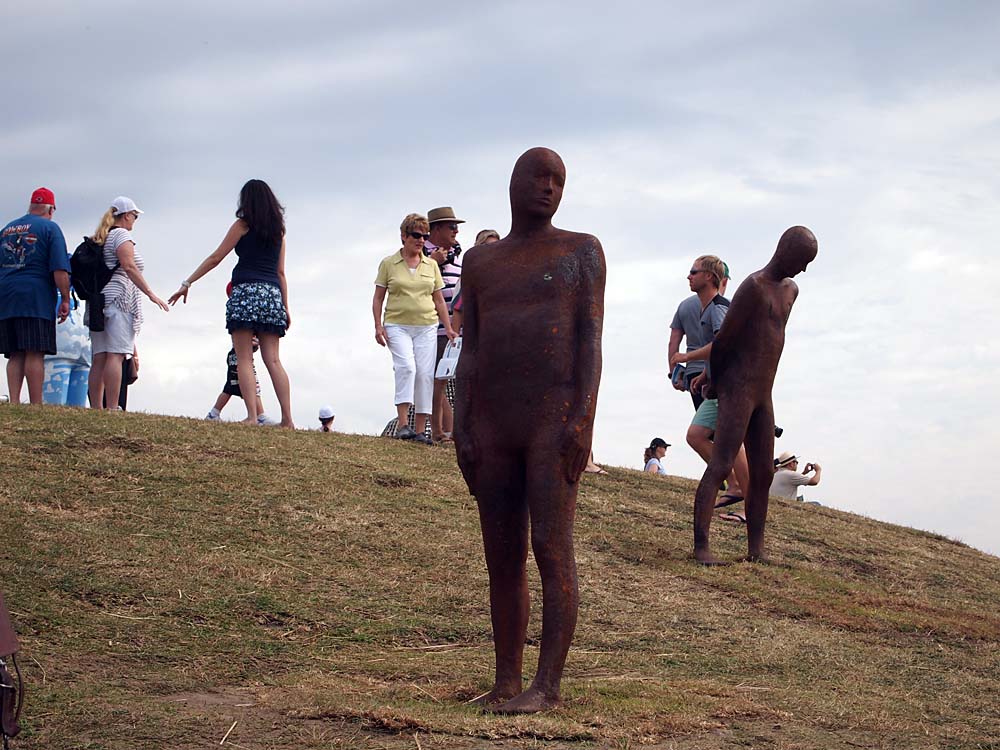
We have been two weeks in Tasmania - family, friends and anti-clockwise around the island, which is 2% of Australia's population in a space of 1% of Australia's territory, geologically, biologically a recalcitrant fragment of our lump of Gondwana traipsing behind the blathery brazen mainland slowly northward, moistened and blown at to greater and lesser degrees by the often over-articulate Southern Ocean, an extraordinary distinctive diversity, not big but as a lady whose husband told us he drove a cart a hundred miles through its wilds 60 years ago said: "If you ironed it out, it'd be as big as Queensland!"
Compare with France: Caesar saw its limits compared with Tasmania (which perhaps fortunately he did not see): 'Gallia est omnia divisa in partes tres' [the whole of Gaul is divided in three parts]. Tasmania, by contrast, I reckon, is divided into six parts:


Compare with France: Caesar saw its limits compared with Tasmania (which perhaps fortunately he did not see): 'Gallia est omnia divisa in partes tres' [the whole of Gaul is divided in three parts]. Tasmania, by contrast, I reckon, is divided into six parts:
- the east coast with its mild weather, beaches and seafood;
- the north with its comparative warmth and moist climate and extraordinary farm fertility and colour;
- the west coast facing the sea
- the mountains and lakes of the interior
- Hobart and hinterland, old colonial and waters tumbling through pastoral worlds rushing to the sea in 1/20th of the distance the waters of the Murrumbidgee and Murray take from comparable landscape on the Monaro, through comparable vertical distance — and without drying up on the way...
- and the sixth wonder: MONA, the Museum of Old and New Art, just upstream from Hobart.
 |
| Hobart, Bicheno (via Frecinet), Launceston (via St Mary's), Smithton (via Penguin), Strahan (via Waratah) and then through winding rainy roads to New Norfolk, just upstream from MONA and oh yes, Hobart and airport. We flew and rented a car — time and money cheaper than driving a car 1000km from home to the overnight ferry (wilderness failure of his graciousness our 1994 Peugeot diesel also possible!) |
Everywhere there is astounding landscape and, more than most of us, Tasmanians actually live in the environment.
There is a warmth of engagement offered by many people, also for the most part modest lives and incomes. Australians who shift to Tasmania are different from those who travel north. They wear shoes, jumpers and they think. The economy struggles, given its small size; there are quarrels over environment. Tourism is a huge element of the economy but tourism is a mixed blessing for tourist-trodden people, not everyone looks pleased to be a servant in a fluctuating industry where the customer often enough is a whinger. "Industry, Industry!" many cry, but (for example) at Waratah, where the tin mine was opened again for several years recently before shut again by the global downturn "...we got nothing, it did nothing, it was all contract, they just blew in and blew out, no work for us, no business for us." Population 200, 50 houses for sale online today.
There is a warmth of engagement offered by many people, also for the most part modest lives and incomes. Australians who shift to Tasmania are different from those who travel north. They wear shoes, jumpers and they think. The economy struggles, given its small size; there are quarrels over environment. Tourism is a huge element of the economy but tourism is a mixed blessing for tourist-trodden people, not everyone looks pleased to be a servant in a fluctuating industry where the customer often enough is a whinger. "Industry, Industry!" many cry, but (for example) at Waratah, where the tin mine was opened again for several years recently before shut again by the global downturn "...we got nothing, it did nothing, it was all contract, they just blew in and blew out, no work for us, no business for us." Population 200, 50 houses for sale online today.
Predominantly the images of Tasmania in the outside world are of wilderness, especially as inspired by Olegas Truchanas, and the darker hues of the national parks and Derwent, as exemplified by the lovely work of Veronica Youd, in whose rental accommodation we stayed for our two last nights, upstream from Hobart. Predominantly the tourist experience is of the resort locations, but we managed to stay mainly in towns, in reasonably priced houses and apartments. These communities were very friendly and conversational places to be.
My photos below predominantly focus away from the familiar wilderness.
Here is rocky coast at Bicheno at dusk, gulls and children waiting for the parent penguins to come ashore to feed their babies in their fish-vomitty, squarky burrows.

Here is rocky coast at Bicheno at dusk, gulls and children waiting for the parent penguins to come ashore to feed their babies in their fish-vomitty, squarky burrows.

Here is the [Fairly] Big Penguin of Penguin, also under seagull guard

and here perhaps a dreaming of customers at the fabulous and fabled Penguin Sunday Market

Here are colours of the human-imprinted Northwest. I was staggered by what I could see if I really looked as we drove, thank you Helen for driving most of the way, thank you cameras (now an Olympus E-PL1 with standard zoom or with my old 50mm f1.4:1 Nikon lens to see in the dark) for having enabled me to capture and show such as I began to see in Italy long ago.
CLICK ON ANY PHOTO FOR A SLIDESHOW OF ALL


 |
| If you look carefully at the hedgerow above , you will see that this is in fact a photo of the famous 'Nut' of Stanley ... or, it seemed to us, 'StanleyWorld' - so picturesque and fully tourist focused. |


 |
| Some of these photos are taken from the car at highway speed |


and then we headed south through mountains to Strahan which to get to seems way down the west coast but while the most southerly town is in fact not half way down the coast, the rest of the south west being wilderness


Strahan is on beautiful Macquarie Harbour, an old fishing port... but you cannot buy a fresh fish to cook... The population is under 1000, with tourist surges. Retail of anything except catered tourism is precarious. A town which is shaped for tourists, like Strahan or Stanley on the north coast does look like, well, it's shaped for tourists. We escaped not on the rack railway ($133 or $220 per person) which we were told not to miss, but up the road from the supermarket to Lette's Bay where we found the habitations of locals and the wonders of heath plants.


We were in Strahan on two of the few days in the year without rain (the boy on the checkout at the supermarket said it rained 350 days of the year, apologised for the strange weather we were getting.
As Chinese friends might, we looked around here as elsewhere and said 'so many people could live here!' (as did demographer W.D. Borrie in his report on Australia's future population to the Whitlam Government in the 1970s, when he suggested that Tasmania, if developed like Manhattan, had resources for 60 million people, as I recall). But where large populations could be managed in the north, in the southwest the land is more fragile and vulnerable, be it in rainforest or heath. The secret would seem to be in finding the right kinds of settlement (not mind-numbing clear-felling timber) and making it work in the environment with strong local planning, limiting urban spread, building up not out, using modern technology for energy efficiencies, comfort and communication. A leap forward from simply butting heads together in endless arguments.


We were in Strahan on two of the few days in the year without rain (the boy on the checkout at the supermarket said it rained 350 days of the year, apologised for the strange weather we were getting.
As Chinese friends might, we looked around here as elsewhere and said 'so many people could live here!' (as did demographer W.D. Borrie in his report on Australia's future population to the Whitlam Government in the 1970s, when he suggested that Tasmania, if developed like Manhattan, had resources for 60 million people, as I recall). But where large populations could be managed in the north, in the southwest the land is more fragile and vulnerable, be it in rainforest or heath. The secret would seem to be in finding the right kinds of settlement (not mind-numbing clear-felling timber) and making it work in the environment with strong local planning, limiting urban spread, building up not out, using modern technology for energy efficiencies, comfort and communication. A leap forward from simply butting heads together in endless arguments.
 |
| Dusk |
 |
| Macquarie Harbour |
We did not go back to Hobart at the end of our trip but to its western edge, at New Norfolk, again choosing a town not a resort. Here is a view down the Derwent (Hobart not far down there by road but out of sight) from a lookout opposite New Norfolk.
Down there, where a small river, the Lachlan, enters the Derwent on the right, we saw a platypus. Taken me almost seventy years to see a platypus in the wild... !
Here is a little movie:
THERE IS A LITTLE DEVICE TO CLICK
AT THE BOTTOM RIGHT OF MOVIE
TO SEE IT ON FULL SCREEN
~~~~~ AND SO TO THE SIXTH WONDER
I wrote this review at tripadvisor.com:
We find the new MONA to be a gallery of world importance—and the world seems to be coming to see it now. It is so good to be able to wander through and be immersed in a whole enclosed environment, the underground building and the art, without interpretation everywhere. You can delve into lots of commentary on an iPod-like device provided. The senses and mind assaulted variously, mind-shifting: don't go if you don't enjoy that.
It hides in a vineyard in a suburb. on a small peninsula on the river.


It hides in a vineyard in a suburb. on a small peninsula on the river.

The staff are not haughty or intimidating but smile and converse.
You can use camera but not flash. This is an odd collection below. So is MONA; not appropriate to try to add some form, other than perhaps my own sight,.... also I was absorbed more in the visceral than the digital and the camera battery died.
Photos have their own life and meaning, these are from me, not MONA. And as usual, the people are art forms too.
 |
| Well yes, there is a bit of printed info at the beginning... |
 |
| People do look beautiful |
 |
| The artist's statement for this hollowed out recumbent full sized human form is: This work, with its glass display case,
draws attention to the sinister way museums and art institutions
alienate visitors from their own emotions.
—very much a statement of what MONA works hard to avoid being. |


 |
MY BEAUTIFUL CHAIR 2010Greg Taylor. Dr Philip NitschkeHe has tapped the screen and assisted death is under way,on his own initiative and by his own decisions. He did not have to sit there and discover the experience. This is a very moving exhibit. The thing in his hand is not a needle in his arm, perhaps his finger makes the point. Here we exit. Moved and alive. OR WAIT, THIS IS NOT AT MONA BUT PERHAPS IN THE SPIRIT OF MONA ... and to lighten things up again |